Organizations’ AI Success Starts With an Employee Skills Strategy: New Guide Published by HR Advisory Firm McLean & Company
TORONTO, Nov. 3, 2026
Press Release Disclaimer: This is a press release distributed through the XPR Media network. It has not been independently verified by our newsroom.

Organizations’ AI Success Starts With an Employee Skills Strategy: New Guide Published by HR Advisory Firm McLean & Company
Canada NewsWire
TORONTO, Nov. 3, 2026
A new resource from global HR research and advisory firm McLean & Company provides a structured approach to defining and embedding the technical and durable skills employees need to support organizational AI priorities.
TORONTO, Nov. 3, 2026 /CNW/ — Many organizations are moving faster on AI tools than on the workforce capabilities needed to use them effectively, responsibly, and in support of business priorities, according to observations from global HR research and advisory firm McLean & Company. To help HR leaders bring clarity and structure to this work, the firm has published its new Define AI Skills Guide, a resource designed to help organizations define the skills required to deliver on their AI priorities and build workforce readiness.
In the new guide, McLean & Company explains that defining AI skills is not a one-time exercise. As organizational AI priorities, requirements, and capabilities change, the skills needed across the workforce will change with them.
“Effective AI skills development can’t happen in the absence of an AI strategy,” says Lisa Highfield, principal director, HR Research & Advisory Services at McLean & Company. “The pace of change is not letting up. As agentic AI reshapes work, HR needs strategic direction to understand how work may change and be intentional about the capabilities it builds. The goal isn’t simply to prepare employees to use AI today. It’s to build workforce capability that maximizes the potential value of AI, adapts as work evolves, and strengthens the organization’s readiness for what comes next.”
The firm recommends that HR leaders begin by clarifying the driving need and scope for AI skills, then build and regularly refine an AI skills library that reflects the organization’s strategy, context, and workforce needs.
According to McLean & Company’s insights published in the resource, workforce AI skills fall into two categories: technical skills and durable skills.
Technical skills, such as AI tool fluency, responsible AI use, and critical evaluation of AI outputs, help employees work with AI effectively.
Durable skills, including curiosity, flexibility, and attention to detail, help employees apply judgment and adapt as work changes. McLean & Company notes that a future-ready approach balances both categories for effective AI use with uniquely human skills that endure through change.
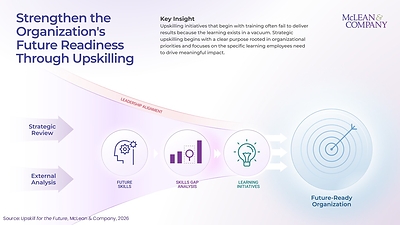
The firm’s Define AI Skills Guide organizes this work into four steps HR leaders can follow, from clarifying the strategic need to embedding prioritized skills across the organization:
- Establish the driving need and scope. Clarify why AI skills are needed and which roles or functions are most critical to organizational priorities.
- Build the organization’s AI skills library. Review prebuilt skills, then tailor the definitions and proficiency expectations to the organization’s context and needs.
- Review and prioritize AI skills. Evaluate the tailored library against the driving need, then shortlist the skills most critical for helping employees use AI effectively and deliver on organizational priorities.
- Plan to embed AI skills across the organization. Integrate prioritized AI skills into upskilling, workforce planning, learning, and related HR practices, and revisit the skills library as AI priorities evolve.
McLean & Company’s AI Skills Library includes 19 foundational skills – nine technical and 10 durable – that organizations can tailor to support effective AI transformation. The guide advises testing the AI skills library with functional subject matter experts and reviewing it after major tool updates or changes to AI strategy. Because AI technologies and organizational priorities will continue to change, this validation helps ensure the selected skills remain relevant, accessible, and consistently understood across teams and roles.
To access the guide, please visit McLean & Company’s Define AI Skills Guide page.
For related support, HR leaders can explore McLean & Company’s Enable Your AI Organizational Strategy Through HR workshop or the firm’s Facilitated Leadership Training: AI Skills for Leaders.
Media seeking research-backed insights or commentary from McLean & Company experts on AI skills, workforce upskilling, skills strategy, AI transformation, or the future of work can contact kking@mcleanco.com.
About McLean & Company
McLean & Company is a global HR research and advisory firm and trusted partner to people leaders navigating today’s most pressing workforce challenges. Informed by its work with thousands of HR professionals and executives, the firm provides evidence-based research, diagnostics, practical tools, hands-on support, and services spanning advisory, learning, and coaching. From workforce strategy and leadership to culture, engagement, retention, and AI adoption, McLean & Company helps leaders move from direction to execution and deliver measurable results for their people and organizations.
McLean & Company is a division of Infotech.
Media professionals can register for unrestricted access to research across IT, HR, and software, and hundreds of industry analysts through the firm’s Media Insiders program. To gain access, contact pr@mcleanco.com.
 View original content to download multimedia:https://www.prnewswire.com/news-releases/organizations-ai-success-starts-with-an-employee-skills-strategy-new-guide-published-by-hr-advisory-firm-mclean–company-302926732.html
SOURCE McLean & Company